

A Structured Approach to Visual Creation and Image Generation
AI tools are transforming filmmaking—but strong visuals don’t come from tools alone. The difference lies in how we guide the AI.
Today, many creators use AI as a trial-and-error system. But in professional workflows, AI is used through structured prompting, where each prompt plays a specific role in constructing the final image.
This is where Prompt Types become essential.
What are Prompt Types in AI Filmmaking?
Prompting is not a single instruction. It is a layered system, where different prompts control different aspects of visual generation.
This structure helps:
- maintain consistency
- control composition and lighting
- improve realism
- reduce random outputs
Structured prompting is widely used in modern AI workflows because it produces more reliable and scalable results compared to generic prompts
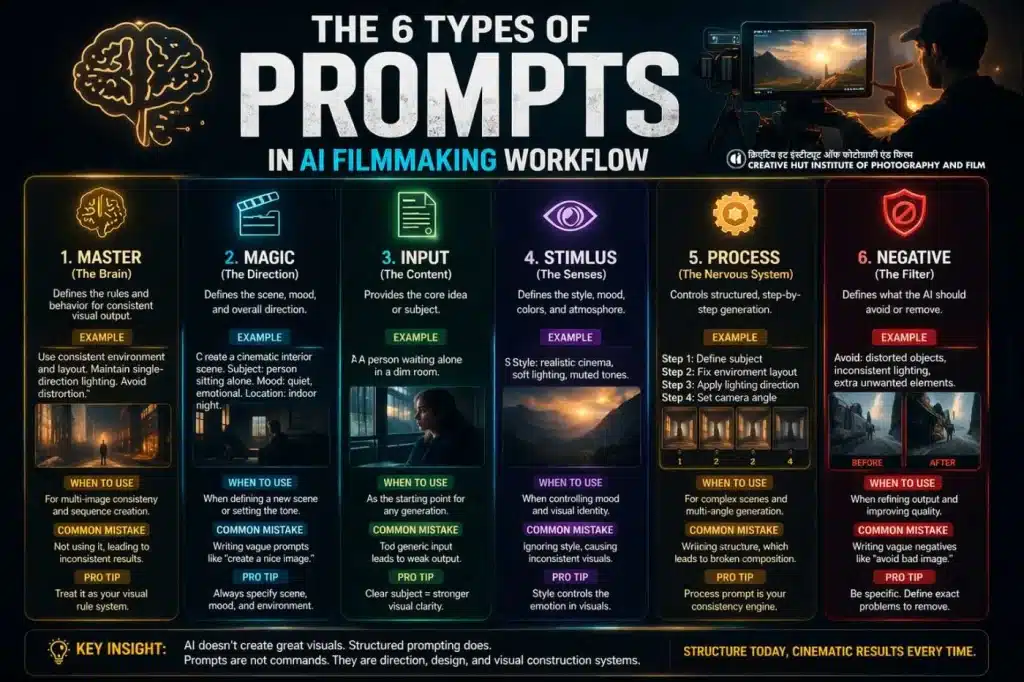
The 6 Types of Prompts in AI Filmmaking
- Master Prompt – Defines rules and behavior
- Magic Prompt – Defines scene and direction
- Input Prompt – Provides content
- Stimulus Prompt – Defines style and mood
- Process Prompt – Controls structured generation
- Negative Prompt – Removes unwanted output
1. Master Prompt (The Brain)
The Master Prompt defines how the AI behaves across the entire workflow.
It ensures:
- consistent composition
- stable lighting direction
- controlled visual output
Example:
Use consistent environment and layout.
Maintain single-direction lighting.
Avoid distortion and unrealistic geometry.
When to Use:
- multi-image generation
- sequence creation
- maintaining visual continuity
Common Mistake:
- Using no Master Prompt → results become inconsistent
Pro Tip:
Treat Master Prompt as a visual rule system, not just instructions.
2. Magic Prompt (The Direction)
The Magic Prompt defines what the AI should create.
It controls:
- subject
- mood
- scene
- environment
Example:
Create a cinematic interior scene.
Subject: person sitting alone
Mood: quiet, emotional
Location: indoor night
When to Use:
- defining a new scene
- setting emotional tone
- directing output
Common Mistake:
- Writing vague prompts like “create a nice image”
Pro Tip:
Always specify scene + mood + environment together
3. Input Prompt (The Content)
The Input Prompt provides the core idea or subject.
Example:
A person waiting alone in a dim room.
When to Use:
- starting point for any generation
- defining subject clearly
Common Mistake:
- Too generic input → weak output
Pro Tip:
Clear subject = stronger visual clarity
4. Stimulus Prompt (The Senses)
The Stimulus Prompt defines how the image should feel visually.
It controls:
- cinematic tone
- realism
- color mood
- atmosphere
Example:
Style: realistic cinema, soft lighting, muted tones
When to Use:
- controlling mood
- maintaining visual identity
Common Mistake:
- Ignoring style → inconsistent visuals
Pro Tip:
Style controls emotion in visuals
5. Process Prompt (The Nervous System)
The Process Prompt ensures step-by-step visual construction.
Example:
Step 1: Define subject
Step 2: Fix environment layout
Step 3: Apply lighting direction
Step 4: Set camera angle
When to Use:
- complex scenes
- multi-angle generation
- structured workflows
Common Mistake:
- Skipping structure → broken composition
Pro Tip:
Process Prompt = consistency engine
6. Negative Prompt (The Filter)
The Negative Prompt defines what the AI should avoid.
Example:
Avoid:
- distorted objects
- inconsistent lighting
- extra unwanted elements
When to Use:
- refining output
- removing errors
- improving quality
Common Mistake:
- Writing vague negatives
Pro Tip:
Be specific: define exact problems to remove
Before vs After Structured Prompting
Without Structure:
- random composition
- inconsistent lighting
- unstable output
With Prompt Types:
- consistent visuals
- controlled lighting
- cinematic composition
Structured prompting improves reliability because AI responds better to clear constraints and defined inputs.
Why This System Matters
Modern filmmaking is becoming faster and more flexible with AI tools, allowing creators to generate visuals, test ideas, and refine scenes efficiently .
But without structure:
- visuals become unpredictable
- storytelling weakens
- quality drops
With structured prompt types:
- visuals become consistent
- storytelling improves
- production becomes scalable
Creative Hut Perspective
At Creative Hut Institute of Photography and Film, visual storytelling is built on structure.
Light is language.
Composition is grammar.
Structure creates meaning.
AI must follow the same principles.
Final Insight
AI does not create strong visuals. Structured prompting creates strong visuals.
Prompts are not commands.They are:
- visual construction systems
- direction
- design
Example
1. The MASTER Prompt (The Brain/Rules)
“You are a professional Screenwriter. Maintain a Neo-Realist tone. Focus on internal monologue expressed through external actions. Use industry-standard screenplay formatting. Rule: No ‘voice-over’—show, don’t tell.”
2. The MAGIC Prompt (The Direction/Vision)
“Enhance this: A 45-year-old man enters a high-end, neon-lit shopping mall. Make the atmosphere feel overwhelming, sterile, and slightly alienating. The sounds of consumerism should feel like background static.”
3. The INPUT Prompt (The Content)
“Character: ARTHUR (45). He is wearing a worn-out suit. He is looking for a specific gift but feels out of place among the younger, wealthier crowd.”
4. The STIMULUS Prompt (The Senses)
“Style: Cold blue lighting, fast-paced ‘shaking’ camera movement. The dialogue (if any) should be muffled or distracted.”
5. The NEGATIVE Prompt (The Filter)
“Avoid: Clichés like him tripping or looking amazed. Avoid bright, happy ‘mall music’ descriptions. No internal thoughts written in the dialogue.”
Result
The Result (The Screenplay Dialogue)
INT. CRYSTAL PLAZA MALL – NIGHT
The automatic glass doors HISSS open.
ARTHUR (45) steps in. He pauses. His suit is clean but the cuffs are frayed—a relic from a decade ago.
Above him, a four-story digital screen blasts a perfume ad. The bass vibrates in his teeth.
He checks a crumpled piece of paper in his hand. He looks up at the Directory—a glowing holographic map.
ARTHUR (to himself, barely audible) Level four. Or three.
A TEENAGER in an oversized hoodie brushes past him, nearly knocking the paper from his hand. The kid doesn’t look back.
Arthur adjusts his tie. He looks at his reflection in a storefront window: ‘GUCCI.’ He looks small against the gold-plated mannequin.
MALL CONCIERGE (O.S.) Can I help you find a specific brand, sir?
Arthur turns. The Concierge is twenty years younger, smiling with teeth that cost more than Arthur’s car.
ARTHUR I’m looking for… ‘The Blue Box.’ For a graduation.
CONCIERGE (pointing toward a glass elevator) Third floor. Past the champagne bar. You can’t miss the glow.
Arthur nods. He heads toward the elevator, walking like a man crossing a minefield.